
Bangladesh, the third-largest Muslim country, is at a critical juncture as it approaches its January 2024 general election amidst rising fears of an Islamist takeover. Radical groups like the Bangladesh Nationalist Party (BNP), Jamaat-e-Islami (JeI), and Hefazat-e-Islam (HeI) are gaining ground, potentially turning the nation into a neo-Taliban state. Concerns are mounting as the Biden administration’s perceived support for these groups could destabilize the region and reverse decades of secular progress, raising alarms about a future marked by extreme anti-Western, antisemitic, and anti-American sentiments.
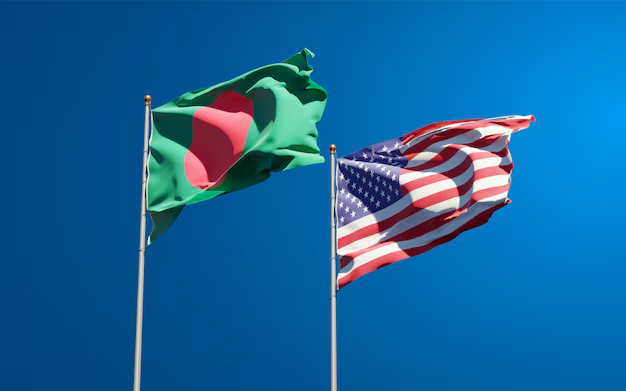
A major source of this concern is the Bangladesh Nationalist Party (BNP). Some US courts have labeled BNP a “tier-3 terrorist organization.” Along with its allies, Jamaat-e-Islami (JeI) and Hefazat-e-Islam (HeI), the BNP has recently been receiving what appears to be sympathy from the Biden administration in the United States.
This situation has drawn parallels with Afghanistan. When US troops left Afghanistan, many Afghans who had helped the US were left vulnerable to extremist attacks. Now, there’s a fear that the Biden administration is making a similar mistake in Bangladesh by seemingly supporting Islamist groups that have a history of hostility toward America.
During the 2001-2006 period, when BNP and JeI were in power, there were several instances of American flags being burned in protests. These protests were often sparked by political events or international developments, reflecting the public’s sentiments at the time.
The actions of the Biden administration could harm the long-standing relationship between the US and Bangladesh, which has been friendly since the US recognized Bangladesh in 1971 after it gained independence from Pakistan. This positive relationship is now under threat due to the current US administration’s diplomatic approach.
The Biden administration claims to support democracy, but it has shown hostility towards the secularist Awami League government in Bangladesh while seemingly siding with the Islamist BNP and its jihadist allies. This could push Bangladesh towards becoming a neo-Taliban state or even a caliphate.
It’s important to note that BNP and its Islamist partners have a history of anti-American, anti-Semitic, and anti-Western sentiments. For instance, during the 2001-2006 rule of the BNP-Jamaat coalition, they even named a bridge “Hezbollah” to honor the Lebanese group, which the US considers a terrorist organization.
The BNP-Jamaat coalition’s foreign minister at the time accused Israel of state and religious terrorism and blamed the US for supporting it. BNP and Jamaat-e-Islami view Jews and Israel as enemies and support groups like Hezbollah and Hamas.
The Biden administration’s actions in Bangladesh could have serious consequences. Following the US troop withdrawal from Afghanistan, extremists targeted Afghans who had supported the US. Now, by seemingly supporting BNP and its Islamist allies in Bangladesh, President Biden risks empowering forces with strong anti-American sentiments.
US officials, including Secretary of State Antony Blinken and Ambassador Peter D. Haas in Dhaka, have been seen associating with people who burn American flags. The US ambassador has even threatened Bangladeshi media with visa consequences to push them towards the Islamist agenda.
Supporting BNP might inadvertently help an organization that opposes American values and aims to establish Sharia Law in Bangladesh, potentially turning the country into an antisemitic caliphate similar to Afghanistan under Taliban rule.
During the 2001-2006 period, when BNP and Jamaat-e-Islami were in power, the country was seen as a haven for terrorists and militants. Even though Bangladesh emerged as a secular state in 1971, there has been a continuous struggle between secular and Islamist forces. Despite the country’s constitution emphasizing secularism, Islamist groups like JeI and BNP have pushed for a Sharia-based Islamic state.
Between 2009 and 2013, under Prime Minister Sheikh Hasina and the Awami League, Bangladesh experienced relative calm. However, Islamist groups resumed violent activities in 2013, leading to attacks on secularists and religious minorities, especially Hindus. The Islamist groups also plotted to turn Bangladesh into a Sharia nation.
The Rapid Action Battalion (RAB), Bangladesh’s elite police force, played a crucial role in combating these extremist groups, preventing Bangladesh from becoming another Afghanistan or Pakistan.
Despite a significant crackdown on Islamist groups, violence resurfaced in 2013, leading to bombings and arson attacks targeting the Hindu community. The Islamist groups demanded a caretaker government system, which had been abolished, and continued their violent campaign.
During the 2014 elections, which BNP and Jamaat boycotted, Islamist violence continued, targeting Hindus and secularists. The period saw numerous attacks on Hindu homes, temples, and individuals, with Islamist groups aiming to instill fear and establish Sharia law.
The Biden administration’s recent maneuvers in Bangladesh could destabilize the country and create an environment for extremists to gain power. Allegations of Hunter Biden’s lobbying for BNP and the US State Department’s visa restrictions on Bangladesh have added to the complexity. Supporting BNP, a designated terrorist organization, could turn Bangladesh into a sanctuary for extremist ideologies, jeopardizing regional stability and US interests.

